
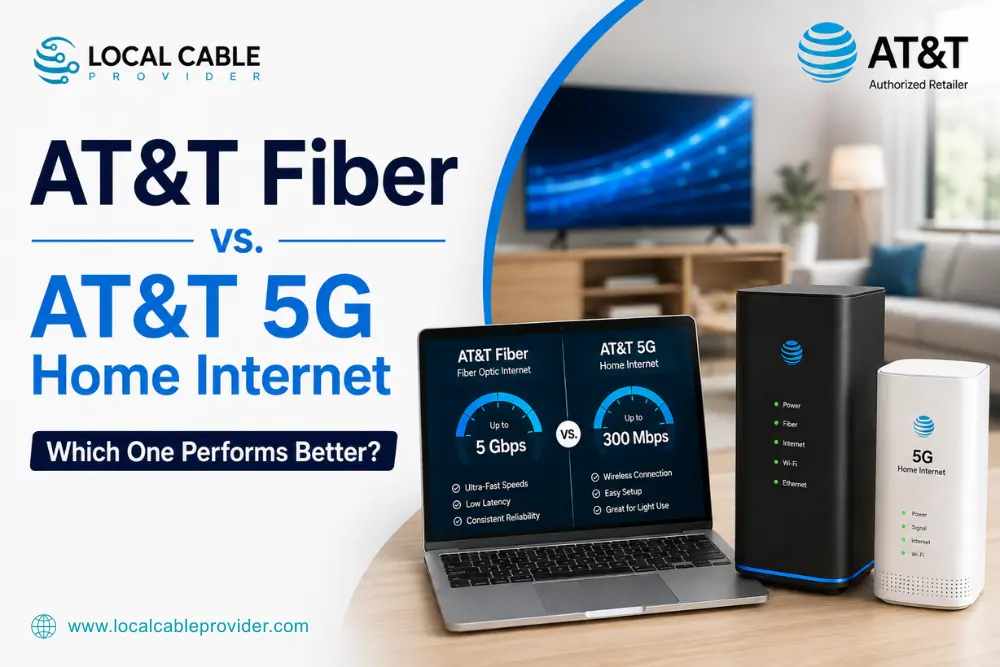
AT&T offers two very different home internet services. AT&T Fiber uses a fiber optic line connected to your home, while AT&T 5G Home Internet, officially called AT&T Internet Air, connects through the company’s wireless network. Both include unlimited data and no annual contract, but they do not deliver the same level of performance.
The honest answer is simple. If AT&T Fiber is available at your address, it is the stronger service. Internet Air is most useful where fiber has not arrived or when easy self setup matters more than maximum speed and consistency.
Quick Answer
| Category | AT&T Fiber | AT&T Internet Air |
| Connection | Fiber optic line | Fixed wireless using 4G LTE and 5G |
| Download speed | Up to 5 Gig | Typically 90 to 300 Mbps |
| Upload speed | Equal to download speed | Typically 8 to 30 Mbps |
| Typical latency | About 10 to 12 milliseconds | About 35 to 65 milliseconds |
| Data cap | None | None |
| Annual contract | None | None |
| Installation | Technician may be required | Self setup |
| Best for | Gaming, remote work, creators, and busy homes | Everyday use where fiber is unavailable |
| Performance winner | AT&T Fiber | Better for convenience and availability |
The Main Difference Is the Connection
Fiber carries data as light through a physical line running to the property. This gives AT&T Fiber high capacity, fast uploads, low latency, and predictable performance throughout the day.
Internet Air sends data between an indoor All Fi Hub and a nearby AT&T cellular tower. It is much easier to install, but speed can change based on tower distance, local capacity, terrain, interference, gateway placement, and the number of nearby users.
That difference matters more than an impressive speed test taken once. A wired fiber connection is generally stable. A wireless connection may perform differently in the morning, during the evening rush, or after the gateway is moved to another room.
Download and Upload Speeds
AT&T Fiber offers tiers from 300 Mbps through 5 Gig. Internet Air typically delivers 90 to 300 Mbps for downloads, according to AT&T’s published performance information. That range is enough for browsing, video calls, and multiple streams, but it is not a fixed speed tier. AT&T does not promise a minimum Internet Air speed.
The larger difference appears in uploads. Every Fiber tier is symmetrical, while Internet Air typically provides 8 to 30 Mbps for uploads. Fiber is therefore much better for cloud backups, security cameras, livestreaming, video publishing, and large work files.
Latency and Consistency
Latency is the time data takes to travel between your device and the network. Lower latency makes games, websites, video meetings, and voice calls feel more responsive.
AT&T reports typical Fiber latency of roughly 10 to 12 milliseconds. Internet Air typically ranges from 35 to 65 milliseconds. Both can handle ordinary online activity, but Fiber has a clear advantage for competitive gaming, live communication, and other real time tasks.
Fiber also handles a busy household more comfortably. If several people are gaming, streaming, uploading, and joining meetings at once, its greater capacity helps prevent one activity from affecting another. Internet Air may still work well, but its performance depends more heavily on the conditions around your home.
Price, Equipment, and Installation
| Feature | AT&T Fiber | AT&T Internet Air |
| Current starting price | Around $35 per month with eligible discounts | Around $55 per month |
| Equipment | Gateway included | All Fi Hub included |
| Data | Unlimited | Unlimited |
| Contract | No annual contract | No annual contract |
| Setup | Professional installation may be needed | Customer self setup in most cases |
Prices and eligibility vary by address. Review the Broadband Facts label because an advertised price may require AutoPay, paperless billing, or a promotion. Check the current AT&T Fiber plans and AT&T Internet Air offer for your location.
Internet Air wins on setup. Its All Fi Hub normally connects through the Smart Home Manager app without a technician. A new Fiber connection may require a technician, and AT&T says installation commonly takes four to six hours. Fiber can still offer better value where promotions provide faster service for a similar monthly price.
Which Is Better for Streaming, Gaming, and Work?
Both services can stream video. A stable Internet Air connection should support several HD or 4K streams, making it practical for a smaller household with ordinary needs.
Fiber is better for heavy simultaneous use because streaming is less likely to slow when someone downloads a game or backs up a computer. Our guide to choosing the right internet speed explains what common activities require.
For gaming, Fiber wins because lower latency reduces lag. Internet Air can support casual play, but congestion may cause sudden changes in response time.
For remote work, Fiber’s fast uploads improve meetings, cloud applications, and large transfers. Internet Air can handle normal office tasks, but people who depend on a stable connection should favor Fiber.
The Internet Air Detail Customers Should Know
Internet Air uses available capacity on AT&T’s mobile network. AT&T states in its network management disclosures that the service is subject to congestion based management. In rare cases, heavy use that contributes to congestion can result in temporarily reduced speeds.
Not every customer will experience slowdowns, but Internet Air quality is unusually address specific. Strong AT&T phone service is encouraging, yet it does not guarantee identical home internet performance.
Before canceling cable internet, install Internet Air and test it for several days. Run speed tests in the morning and during the evening rush. Try video meetings, gaming, and several simultaneous streams. Keep the old connection active until Internet Air proves that it can handle your normal routine.
What Each Service Does Best
AT&T Fiber: Key Benefits
- Much faster download and upload speeds
- Lower latency for gaming and calls
- Better consistency during busy hours
- More capacity for large households
AT&T Fiber: Potential Drawbacks
- Not available at every address
- A technician visit may be necessary
- Most homes do not need the expensive multi Gig tiers
AT&T Internet Air: Key Benefits
- Simple self setup
- Unlimited data and included equipment
- Useful where fiber or strong cable service is unavailable
- Enough speed for common activities when conditions are good
AT&T Internet Air: Potential Drawbacks
- Speeds can change with signal and congestion
- Uploads are much slower than Fiber
- No guaranteed minimum speed
- Performance can differ from one address to the next
Who Should Choose Each Service?
Choose AT&T Fiber if you want the best performance. It suits busy families, remote professionals, gamers, creators, and anyone who values predictable service. Fiber 300 is enough for most homes, so you do not need 5 Gig simply because it is available.
Choose Internet Air when Fiber is unavailable, your wired service is slow, or easy setup is a priority. It can work well for streaming, browsing, schoolwork, and normal video calls. Make the decision after a home trial, not only from an advertised range or a neighbor’s experience.
Frequently Asked Questions
Is AT&T Internet Air the same as AT&T 5G Home Internet?
Yes. Internet Air is AT&T’s fixed wireless home internet service. It uses available 4G LTE and 5G capacity through an indoor All Fi Hub instead of a fiber or cable line.
Is AT&T Fiber faster than Internet Air?
Yes. Fiber offers plans from 300 Mbps to 5 Gig with equal upload and download speeds. Internet Air typically provides 90 to 300 Mbps downloads and 8 to 30 Mbps uploads.
Is Internet Air good enough for 4K streaming?
Usually, yes. A connection performing within the typical range can support 4K streaming. Results may be less predictable when several devices are active or the local wireless network is congested.
Is AT&T Internet Air good for gaming?
It can handle casual gaming, but Fiber is better for competitive play. Fiber’s lower latency and steadier connection reduce the risk of lag and sudden response changes.
Does either service have a data cap?
No. AT&T advertises unlimited data for both Fiber and Internet Air with no overage charges.
Should I cancel cable before testing Internet Air?
No. Test Internet Air at different times for several days first. Cancel the old connection only after confirming that its speed, latency, and signal quality meet your needs.
The Bottom Line
AT&T Fiber performs better than AT&T 5G Home Internet in every major technical category. It has faster downloads, dramatically faster uploads, lower latency, and greater consistency. If both are available at your address, Fiber is the clear choice.
Internet Air remains a useful alternative where Fiber has not arrived. It is easy to install and capable of handling normal household use, but performance can vary. Test it carefully before replacing an existing wired connection.
Call Local Cable Provider at (409) 273-7460 and we will check AT&T availability, compare current pricing, and help you choose the right service for your address.