
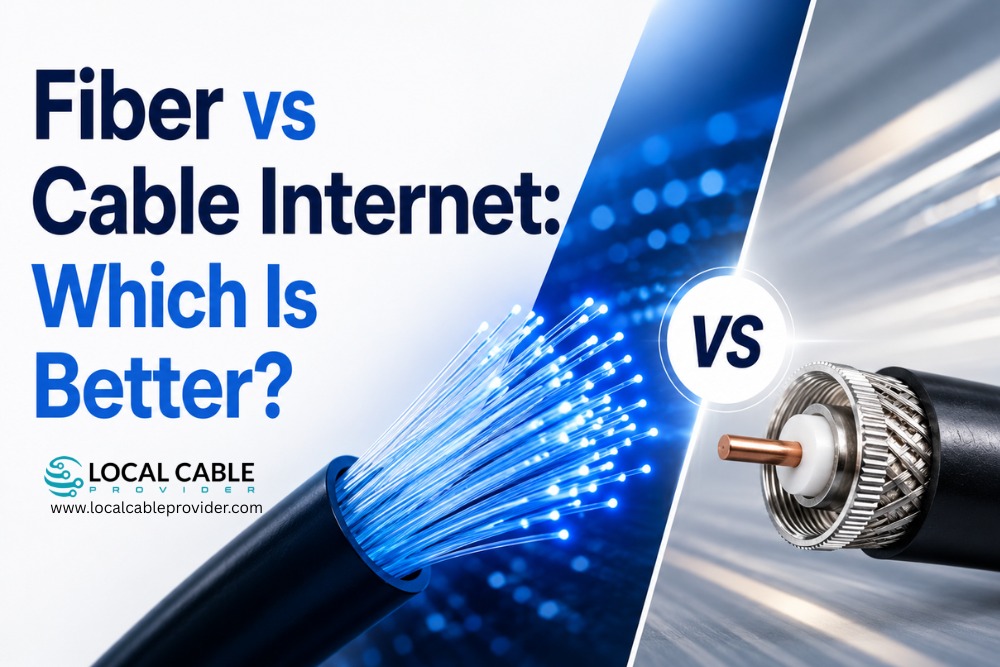
Fiber and cable are the two wired connections most U.S. homes choose between, and the honest answer to “which is better” is: fiber, when you can get it but the full picture is more useful than the one-liner. Here’s how they actually differ, and when cable is the smarter buy.
Fiber vs Cable at a Glance
| Factor | Fiber | Cable |
|---|---|---|
| Download speeds | 200 Mbps – 10,000+ Mbps | 100 Mbps – 2,000 Mbps (up to 10 Gbps where DOCSIS 4.0 is deployed) |
| Upload speeds | Symmetrical (same as download) | 15–35 Mbps typical; up to 200–400 Mbps where “high-split” upgrades have been deployed |
| Latency | 3–10 ms | 20–30 ms typical; can spike well higher under heavy load |
| Peak-hour slowdown | Rare — no shared “node” bottleneck | Possible cable shares bandwidth at the neighborhood level |
| Availability | ~60% of U.S. homes (up sharply from ~45% just two years ago) | ~88–90% of U.S. homes still the most widely available wired technology |
| Typical entry price | ~$30–35/mo (Frontier, AT&T) | ~$25–30/mo (Optimum, Spectrum) |
| Weather/reliability | Most reliable wired option | Very reliable |
Sources: FCC Broadband Data Collection (Version 7, June 2025), the Fiber Broadband Association’s 2026 annual deployment report, and CableLabs’ published DOCSIS 4.0 specifications.
The old “fiber reaches less than half of homes” framing is genuinely outdated. Fiber has expanded faster than almost any broadband technology in U.S. history over the last two years driven by federal BEAD funding and aggressive builds from AT&T and Frontier and now passes 60% of American households. It’s very possible fiber has reached your street since you last checked.
Cable’s Answer: DOCSIS 4.0
Cable isn’t standing still. The newest cable standard, DOCSIS 4.0, is built to close the upload gap that’s defined this comparison for years. Supporting up to 10 Gbps download and 6 Gbps upload, with latency dropping to 10–15 ms on upgraded networks. On paper, that’s directly competitive with fiber.
The catch: rollout is still limited. As of 2026, only a handful of cable operators have DOCSIS 4.0 live in select markets, and most cable customers nationwide are still on the older DOCSIS 3.1 standard — where the asymmetrical upload weakness described above still applies. Ask your provider directly whether DOCSIS 4.0 is available at your specific address; don’t assume it is just because the technology exists.
Where Fiber Wins
Uploads and latency. This is the real difference in daily life. Cable’s 500 Mbps plan downloads fast but uploads at maybe 20 Mbps; fiber’s 500 Mbps plan uploads at 500. There’s also a technical reason cable performance craters specifically when your connection is busy: when a standard cable line saturates say, a phone backing up to the cloud while someone’s on a video call. The cable modem queues the overflow data in a buffer, which adds real, noticeable latency. It’s a known phenomenon sometimes called “bufferbloat,” and it’s why a Zoom call’s ping can jump from a smooth 25 ms to a laggy 200+ ms right when the house gets busy. Fiber’s dedicated line to your home doesn’t share that bottleneck. Fiber lines also don’t slow down when the whole neighborhood gets home at 6 PM.
Providers to know: AT&T Fiber (300 Mbps – 5 Gbps, from ~$35/mo) and Frontier Fiber (500 Mbps – 7 Gbps, from ~$29.99/mo) both include equipment and have no data caps. Not sure if fiber reaches your street? Check AT&T Fiber availability or Frontier availability both worth a fresh look given how fast fiber has expanded recently.
Where Cable Wins
Availability and entry price. Cable still reaches meaningfully more homes than fiber about 88–90% of U.S. households versus fiber’s 60%, though that gap has narrowed considerably in the last two years. If fiber genuinely hasn’t been built on your street, cable remains the widely available, reliable option. Entry pricing also often undercuts fiber: Spectrum starts around $30/mo with a free modem and no contract, and Optimum around $25–30/mo with multi-year price locks. For a household that mostly streams and browses (download-heavy, upload-light), cable delivers most of the experience for less.
Installation: What to Expect
Cable installation is typically same-week, since the line into your home usually already exists — a technician just activates it. Fiber installation can take longer where the line hasn’t reached your building yet, sometimes requiring a new drop from the street; where fiber is already run to the neighborhood, it’s just as fast as cable. Ask your provider for an installation timeline before you commit, especially if you’re on a deadline (moving in, canceling another service).
Which Should You Choose?
- Both available? Take fiber if the prices are within ~$10/mo the uploads, latency, and consistency are worth it. Take cable if it’s meaningfully cheaper and your household mainly streams.
- Work from home / content creator / serious gamer? Fiber, not close.
- Only cable available? It’s genuinely good to get a 300–500 Mbps tier and don’t overthink it.
- Neither? 5G home internet or satellite call us and we’ll map your real options.
The deciding factor is always your address. Check what’s available in your area or call (409) 273-7460. We’ll tell you in one call whether fiber has reached your street and what it costs versus cable.
Frequently Asked Questions
Is fiber internet worth the extra cost?
Where it costs more at all (often it doesn’t anymore), yes for upload-heavy households video calls, cloud backup, gaming, content creation. Streaming-only households can save with cable.
Is cable internet fast enough for 4K streaming?
Easily, 4K uses ~15–25 Mbps per stream. Cable’s weakness is upload, not download.
Why is my cable internet slow in the evening?
Cable bandwidth is shared at the neighborhood level, and when your line gets busy, the modem can queue overflow data in a buffer that adds real latency a phenomenon called “bufferbloat.” Fiber’s dedicated connection avoids this; newer DOCSIS 4.0 cable networks reduce it significantly, but aren’t yet widely deployed.
Can I get fiber at my address?
Fiber now reaches roughly 60% of U.S. homes, up from about 45% just two years ago. A faster expansion than almost any broadband technology in recent history. It’s genuinely worth rechecking even if you looked a year or two ago. We check fiber, cable, and 5G availability for your exact address.
The Bottom Line
Fiber is the better technology; cable is the more available one, and often the cheaper one. If fiber serves your address at a comparable price, take it. If not, a mid-tier cable plan is an excellent connection that most households will never outgrow. Not sure how much speed you actually need either way?
See our complete internet speed guide. For a full rundown of which providers offer which technology, see our 2026 best internet providers guide. Either way, the answer starts with an address check call (409) 273-7460 and we’ll run yours.