
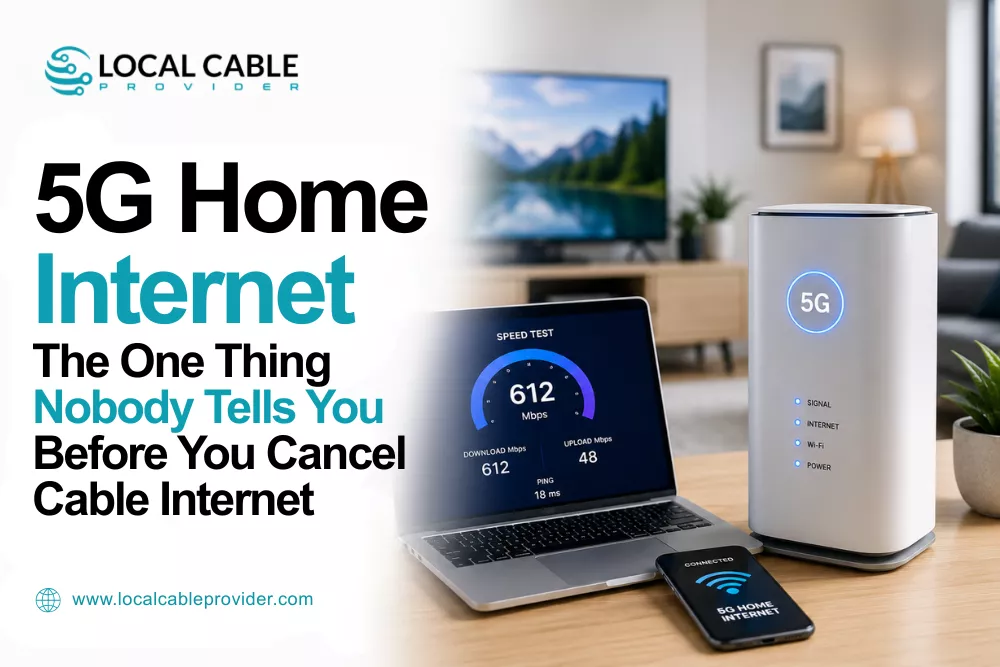
5G home internet looks like an easy escape from cable. Equipment is usually included, installation takes minutes, and the leading plans offer unlimited data.
The complication is that advertised speed does not tell you how consistent the connection will be at your address. Before canceling cable, you need to test 5G during the busiest hours in your home. Here is why that matters.
Quick Answer
| Category | Finding |
| The one thing to know | 5G performance depends heavily on local tower capacity, signal quality, and gateway placement |
| Biggest strength | Simple pricing, included equipment, easy setup, and no annual contract |
| Biggest weakness | Speed and latency can change during busy periods |
| Best for | Renters, streaming focused homes, and customers with expensive or slow cable service |
| Less suitable for | Competitive gamers, heavy uploaders, home servers, and work from home users who need maximum consistency |
| Before canceling cable | Test 5G for at least one full week, especially during evenings and weekends |
What 5G Home Internet Actually Is
5G home internet is a fixed wireless service. A gateway receives a signal from a nearby cellular site and converts it into a home WiFi network. Standard plans are generally approved for one address because the provider must confirm that the local tower has available capacity.
Distance from the tower, walls, trees, building materials, and gateway placement can all affect performance.
The One Thing Nobody Tells You:
Consistency Matters More Than Maximum Speed
A 5G speed test can look excellent in the morning and very different in the evening. The reason is that your gateway shares cellular capacity with other users connected to the same tower.
When local demand is low, performance may be excellent. When more phones and home gateways become active, available capacity can decrease, affecting speed and latency.
Cable can also slow during busy hours, but a healthy wired connection is less sensitive to radio conditions and gateway placement. This often makes cable more predictable.
Data priority can also matter. T Mobile states that home internet customers may notice lower speeds during congestion. Customers who use more than 1.2 terabytes in a month can receive further priority reduction during congested periods.
In rare cases, AT&T says Internet Air customers whose usage contributes to congestion may experience speeds as low as 512 Kbps for at least thirty minutes.
Most customers may never experience a serious slowdown. Still, a coverage map cannot predict the complete experience at your address.
Current 5G Home Internet Options in 2026
| Provider | Current pricing | Published performance | Important terms |
| T Mobile Home Internet | $50 for Rely, $60 for Amplified, and $70 for All In with AutoPay | Typical downloads vary by plan, generally reaching from the low 100s into the high 400s | Unlimited data, included gateway, five year price guarantee, and a fifteen day test period |
| Verizon 5G Home Internet | $60 for 5G Home, $70 for Plus, and $85 for Ultimate before eligible mobile discounts | Current maximum downloads are 100 Mbps, 150 Mbps, and 300 Mbps respectively | Router included, unlimited data, thirty day money back guarantee, and price locks lasting three to five years |
| AT&T Internet Air | Starting at $55 per month, with eligible wireless discounts available | Typical downloads of 90 to 300 Mbps and uploads of 8 to 30 Mbps | No annual contract, no overage fee, included gateway, and simple self setup |
Prices and terms were checked in August 2026. Availability, discounts, taxes, and exact performance vary by address. Review the Broadband Facts label before ordering.
5G Home Internet Versus Cable Internet
| Factor | 5G Home Internet | Cable Internet |
| Connection | Wireless signal from a cellular site | Physical coaxial line into the home |
| Speed | Can be fast, but varies more by address and time | Usually more predictable within the chosen tier |
| Latency | Can change with signal and tower demand | Usually steadier, though congestion can still occur |
| Uploads | Often sufficient for normal use, but may fluctuate | Usually lower than downloads, but often more consistent |
| Data | Main plans commonly include unlimited data | Policy depends on the cable provider |
| Installation | Usually completed by plugging in a gateway | May require an active line, setup kit, or technician |
| Equipment | Gateway commonly included | Modem or router charges depend on the provider |
| Advanced networking | Public IP, port forwarding, and bridge features vary | Usually provides more familiar router controls |
If fiber is available at a similar price, it is worth considering before choosing either option. Fiber usually delivers faster uploads, lower latency, and stronger consistency. See our fiber and cable internet comparison for more detail.
Who Should Switch to 5G Home Internet?
5G can be a smart replacement for households that mainly stream, browse, study, and make ordinary video calls. It is also attractive for renters and mobile customers who qualify for bundle savings.
The service makes more sense when cable is expensive or the only wired option is slow DSL. A stable 150 Mbps connection is enough for many families. Our internet speed guide can help you choose a suitable level.
Keep cable, or test longer, if several people work from home, you compete online, upload large files, or need advanced network settings. Some wireless gateways limit public IP access or port forwarding.
How to Test 5G Before Cancelling Cable
Do not cancel cable when the 5G gateway arrives. Keep both services active during the return period and follow this test:
- Try the gateway near different windows and on different floors. Use the provider app to locate the strongest signal.
- Test in the morning, during the workday, in the evening, and on a weekend. Run several tests at each time.
- Record speed, latency, jitter, and packet loss. The lowest repeatable evening result matters more than the fastest result.
- Test real activities, including video meetings, streaming, uploads, gaming, workplace VPN access, and security cameras.
- Confirm the remaining price of any cable television or phone services. Canceling internet may remove bundle discounts.
- Return all cable equipment on time and keep the receipt.
If 5G stays stable during your busiest evening and reduces the total bill, it is a realistic cable replacement.
Frequently Asked Questions
Is 5G home internet reliable enough to replace cable?
Yes, for many households. Reliability depends on the tower, signal, gateway placement, and local demand. Test it before canceling cable.
Does 5G home internet slow down at night?
It can. More customers may use the same cellular site during evening hours. Some addresses experience little change, while others see lower speeds or higher latency.
Is 5G home internet better than cable?
5G often wins on setup and simple pricing. Cable usually wins on predictable performance and advanced networking.
Is 5G home internet good for gaming?
It can be good when latency and jitter remain stable. Competitive gamers should test their actual games during normal playing hours. Download speed alone does not determine gaming quality.
Does 5G home internet have unlimited data?
The main plans from T Mobile, Verizon, and AT&T offer unlimited data or no overage fees. Network management and prioritization policies can still affect performance during congestion.
Can I take my 5G gateway to another location?
Usually not with a standard home plan. Fixed wireless service is normally approved for a specific address. Portable use may require a separate travel plan.
Should I cancel cable before testing 5G?
No. Keep both connections during the trial period and test 5G across several days, devices, and busy hours.
The Bottom Line
5G home internet can replace cable, but the decision should not be based on one impressive speed test. The real question is whether the connection remains stable at your address when your household and neighborhood are busiest.
Test it for a full week, place the gateway carefully, and use every device that matters. If performance remains consistent and the total cost is lower, switching can be a smart move.
Call Local Cable Provider at (409) 273-7460 and we will compare the available 5G, cable, and fiber options at your address, including current prices and realistic speed choices.